


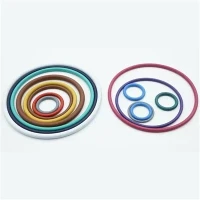


As a trusted NBR O-ring supplier, ensuring the quality of our products is of utmost importance. NBR (Nitrile Butadiene Rubber) O-rings are widely used in various industries due to their excellent resistance to oil, fuel, and other chemicals, as well as their good mechanical properties. In this blog post, I will share some effective methods for testing the quality of NBR O-rings.
Visual Inspection
The first step in testing the quality of an NBR O-ring is a thorough visual inspection. This simple yet effective method can reveal a lot about the O-ring's condition.
- Surface Defects: Carefully examine the surface of the O-ring for any visible defects such as cracks, cuts, holes, or bubbles. These defects can significantly compromise the O-ring's sealing performance and durability. For instance, a small crack can allow fluid to leak through, leading to system failures.
- Dimensional Accuracy: Check the O-ring's dimensions to ensure they meet the specified requirements. Use a caliper or a micrometer to measure the inner diameter, outer diameter, and cross-sectional diameter. Any deviation from the standard dimensions can cause improper fitting and sealing issues. For example, if the O-ring is too large, it may not fit properly in the groove, while if it is too small, it may not provide an adequate seal.
Hardness Testing
Hardness is an important property of NBR O-rings as it affects their sealing ability and resistance to deformation. The hardness of an NBR O-ring is typically measured using a durometer, which measures the material's resistance to indentation.
- Shore A Scale: The most common scale used for measuring the hardness of rubber materials, including NBR O-rings, is the Shore A scale. A higher Shore A value indicates a harder material, while a lower value indicates a softer material. The hardness of NBR O-rings can vary depending on the application, but most commonly, they range from 60 to 90 Shore A.
- Testing Procedure: To perform a hardness test, place the O-ring on a flat, hard surface and press the durometer onto the O-ring. The durometer will display the hardness value on its scale. Take multiple measurements at different points on the O-ring to ensure accuracy.
Tensile Strength Testing
Tensile strength is a measure of the maximum stress a material can withstand before breaking under tension. Testing the tensile strength of NBR O-rings is crucial to ensure they can withstand the forces applied during installation and operation.


- Testing Equipment: A universal testing machine is commonly used to perform tensile strength tests. The O-ring is placed between two grips on the testing machine, and a gradually increasing force is applied until the O-ring breaks.
- Calculation of Tensile Strength: The tensile strength is calculated by dividing the maximum force applied to the O-ring by its cross-sectional area. The higher the tensile strength, the more resistant the O-ring is to breaking under tension.
Elongation at Break Testing
Elongation at break is another important mechanical property of NBR O-rings. It measures the percentage increase in length of the O-ring before it breaks under tension.
- Testing Procedure: Similar to the tensile strength test, the O-ring is placed between two grips on a universal testing machine. As the force is applied, the O-ring stretches until it breaks. The elongation at break is calculated by measuring the increase in length of the O-ring before it breaks and dividing it by its original length.
- Significance of Elongation at Break: A high elongation at break indicates that the O-ring is more flexible and can withstand greater deformation without breaking. This property is particularly important in applications where the O-ring needs to stretch or compress during installation or operation.
Compression Set Testing
Compression set is a measure of the O-ring's ability to recover its original shape after being compressed. It is an important property for ensuring long-term sealing performance.
- Testing Method: The O-ring is placed in a compression fixture and compressed to a specified percentage of its original thickness for a certain period of time at a specified temperature. After the compression period, the O-ring is removed from the fixture and allowed to recover for a specified time. The compression set is then calculated by measuring the remaining deformation of the O-ring.
- Importance of Compression Set: A low compression set indicates that the O-ring can maintain its sealing ability over time, even under repeated compression and relaxation cycles. This is crucial for applications where the O-ring needs to provide a reliable seal for an extended period.
Chemical Resistance Testing
One of the key advantages of NBR O-rings is their excellent resistance to various chemicals. However, it is still important to test the O-ring's chemical resistance to ensure it is suitable for the specific application.
- Immersion Test: The most common method for testing chemical resistance is the immersion test. The O-ring is immersed in a specific chemical or a mixture of chemicals for a specified period of time at a specified temperature. After the immersion period, the O-ring is removed from the chemical and examined for any changes in its appearance, dimensions, or mechanical properties.
- Evaluation Criteria: The evaluation of the O-ring's chemical resistance is based on factors such as changes in weight, volume, hardness, and tensile strength. If the O-ring shows significant changes in these properties, it may not be suitable for use in the presence of the tested chemical.
Aging Resistance Testing
Aging resistance is an important factor in determining the long-term performance of NBR O-rings. Over time, exposure to heat, oxygen, and other environmental factors can cause the O-ring to deteriorate, leading to a decrease in its mechanical properties and sealing performance.
- Accelerated Aging Test: To simulate the effects of long-term aging, an accelerated aging test can be performed. The O-ring is placed in an oven at a high temperature for a specified period of time. After the aging period, the O-ring is removed from the oven and tested for its mechanical properties, such as hardness, tensile strength, and elongation at break.
- Prediction of Long-Term Performance: By comparing the properties of the aged O-ring with those of the unaged O-ring, it is possible to predict the long-term performance of the O-ring in the actual application.
Conclusion
Testing the quality of NBR O-rings is a comprehensive process that involves multiple methods and parameters. By conducting thorough visual inspections, hardness tests, tensile strength tests, elongation at break tests, compression set tests, chemical resistance tests, and aging resistance tests, we can ensure that our NBR O-rings meet the highest quality standards and provide reliable sealing solutions for our customers.
If you are in the market for high-quality NBR O-rings, we invite you to explore our product range. You can find more information about our Ring Nbr, NBR75, and 30mm O Ring Seal on our website. We are committed to providing our customers with the best products and services, and we look forward to discussing your specific requirements and how we can meet them. Contact us for a detailed consultation and let's start a successful business relationship!
References
- ASTM International. (2023). ASTM D2000 - Standard Classification System for Rubber Products in Automotive Applications.
- ISO 3601 - 1:2012. Rubber O - rings - Part 1: Dimensions and tolerances.
- Smith, J. (2022). Handbook of Elastomers. New York: CRC Press.