


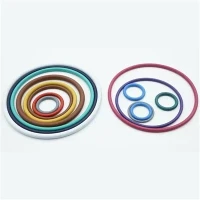


Hey there! I'm a supplier of silicone O - rings, and I know how crucial it is to ensure top - notch quality during production. In this blog, I'll share some key tips on how to make sure your silicone O - rings meet the highest standards.
Material Selection
The first step in ensuring quality is choosing the right silicone material. Not all silicones are created equal. You need to pick a silicone grade that suits the specific application of the O - ring. For instance, if the O - ring is going to be used in a high - temperature environment, you'll want a silicone with excellent heat resistance. Some silicones can withstand temperatures up to 200°C or even higher. On the other hand, if it's for a food - grade application, you must select a silicone that is approved for contact with food. This usually means it meets certain safety and hygiene standards, like being free from harmful chemicals.
It's also important to buy your silicone from a reliable supplier. We all know there are some low - quality materials out there in the market. A good supplier will provide you with material certificates, which show the properties and quality of the silicone. This way, you can be confident that the material you're using is up to par.
Precision in Molding
Once you've got the right material, the next big thing is molding. The molding process is where the shape and size of the O - ring are determined. To get a high - quality O - ring, you need precise molds. The molds should be designed with very tight tolerances. Even a small deviation in the mold can lead to an O - ring that doesn't fit properly.
There are different molding methods for silicone O - rings, such as compression molding, injection molding, and transfer molding. Compression molding is a common method. It involves putting the silicone material into a mold cavity and then applying pressure and heat to shape it. Injection molding, on the other hand, is faster and can produce more consistent results. It works by injecting the molten silicone into the mold under high pressure.
During the molding process, you need to control the temperature and pressure carefully. If the temperature is too high, the silicone might degrade, and the O - ring could end up with a brittle or discolored surface. If the pressure is too low, the O - ring might not have the right density or shape. You should also monitor the curing time. Curing is the process where the silicone hardens and takes on its final properties. If the curing time is too short, the O - ring won't be fully cured, and it might not have the required strength and durability.
Quality Control Checks
After molding, it's time for quality control checks. You can't just assume that the O - rings are perfect. There are several tests you can perform to make sure they meet the quality standards.
One of the basic checks is visual inspection. You need to look at each O - ring carefully for any visible defects, like cracks, bubbles, or uneven surfaces. Even a small crack can cause the O - ring to fail in its sealing function. You can use magnifying glasses or inspection cameras to spot these tiny defects.
Dimensional inspection is also crucial. You need to measure the diameter, cross - section, and other dimensions of the O - ring to make sure they are within the specified tolerances. You can use tools like calipers or micrometers for this. If the O - ring is too big or too small, it won't fit properly in the application.
Another important test is the hardness test. The hardness of the O - ring affects its sealing performance. You can use a durometer to measure the hardness. The hardness should be consistent across all the O - rings in a batch. If the hardness varies too much, it could mean that there were issues during the molding or curing process.
Environmental Testing
Silicone O - rings are often used in different environmental conditions. So, it's important to test them under these conditions to ensure their long - term performance.
For example, if the O - ring is going to be used in a chemical - rich environment, you need to test its chemical resistance. You can immerse the O - ring in the relevant chemicals for a certain period and then check for any changes in its properties, like swelling, cracking, or loss of elasticity.
If the O - ring is for an outdoor application, it needs to be tested for UV resistance. You can expose the O - ring to UV light for a set amount of time and see if it degrades. UV rays can cause the silicone to become brittle and lose its sealing ability over time.


Temperature cycling tests are also important. These tests simulate the changes in temperature that the O - ring might experience in its actual use. You can subject the O - ring to a series of high and low temperatures and then check if it still functions properly.
Employee Training
Your employees play a huge role in ensuring the quality of silicone O - rings. They need to be well - trained in all aspects of production, from material handling to quality control.
When it comes to material handling, employees should know how to store the silicone properly. Silicone can be affected by factors like humidity and temperature. So, it should be stored in a dry and cool place. They also need to handle the material carefully to avoid contamination.
During the molding process, employees need to understand how to operate the molding machines correctly. They should know how to set the right temperature, pressure, and curing time. They should also be able to troubleshoot any problems that might arise during molding.
In the quality control department, employees need to be trained to perform the various tests accurately. They should know how to use the inspection tools properly and how to interpret the test results. Regular training and refresher courses can help keep their skills up - to - date.
Documentation and Traceability
Documentation is an important part of ensuring quality. You should keep detailed records of every step in the production process. This includes information about the material, the molding process (temperature, pressure, curing time), and the quality control tests.
These records can be used for several purposes. First of all, they can help you identify and solve any quality issues that might arise. If you have a batch of O - rings with a problem, you can look back at the records to see what might have gone wrong. They also provide evidence of the quality of your products. If a customer asks for proof of quality, you can show them these records.
Traceability is also related to documentation. You should be able to trace each O - ring back to its raw material and production batch. This can be very useful in case of a recall or a quality issue. If a problem is found with a particular batch of O - rings, you can quickly identify all the affected products and take appropriate action.
Conclusion
Ensuring the quality of silicone O - rings during production is a multi - step process. It starts with choosing the right material, then moves on to precision molding, strict quality control checks, environmental testing, employee training, and proper documentation. By paying attention to all these aspects, you can produce high - quality silicone O - rings that meet the needs of your customers.
If you're in the market for high - quality silicone O - rings, we've got you covered. We offer a wide range of products, including Silicone Quad Rings, Silicone O Ring Seal, and O Ring 55 mm. If you're interested in purchasing our products or have any questions, feel free to reach out to us. We'd love to have a chat and discuss how we can meet your requirements.
References
- "Silicone Rubber Handbook" by David A. Thomas
- "Sealing Technology Handbook" by Leakage Control Institute