


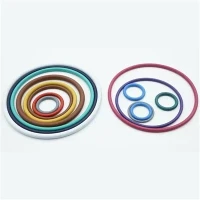

Yo, folks! As a supplier of NBR O - rings, I often get asked about the fatigue resistance of these little but crucial components. So, let's dig deep into what the fatigue resistance of NBR O - ring really means.
First off, what's an NBR O - ring? NBR stands for Nitrile Butadiene Rubber. It's a synthetic rubber that's super popular in the sealing world. NBR O - rings are used in a ton of applications, from automotive engines to industrial machinery. They're known for their good resistance to oil, fuel, and other chemicals.
Now, let's talk about fatigue resistance. Fatigue in the context of O - rings is all about how well they can handle repeated stress and strain over time. When an O - ring is installed in a system, it's usually under some kind of pressure. This pressure can cause the O - ring to deform. And if the system is constantly starting and stopping, or if there are vibrations, the O - ring is going to experience repeated cycles of deformation.
The fatigue resistance of an NBR O - ring determines how long it can last under these conditions without failing. A high - fatigue - resistant O - ring will be able to withstand a large number of deformation cycles before it starts to crack, break, or lose its sealing ability.
There are a few factors that affect the fatigue resistance of NBR O - rings. One of the big ones is the hardness of the rubber. Generally, harder NBR O - rings tend to have better fatigue resistance. For example, O Ring Nbr90 with a hardness of 90 durometer is often more resistant to fatigue compared to softer ones. The reason is that harder rubber can better maintain its shape under stress. It's less likely to be permanently deformed, which means it can keep performing its sealing function for a longer time.
Another factor is the quality of the raw materials used to make the O - ring. High - quality NBR rubber with the right chemical composition and molecular structure will have better fatigue properties. At our company, we source the best NBR materials to ensure that our O - rings have top - notch fatigue resistance. We also pay close attention to the manufacturing process. Proper mixing, curing, and molding are essential to produce O - rings with consistent and reliable fatigue performance.
The operating environment also plays a huge role. Temperature is a major factor. If the O - ring is exposed to high temperatures, the rubber can become softer and more prone to fatigue. On the other hand, extremely low temperatures can make the rubber brittle, which also reduces its fatigue resistance. Chemical exposure is another thing. If the O - ring is in contact with aggressive chemicals, it can cause the rubber to swell, degrade, or become more susceptible to fatigue.
Let's take a look at some real - world examples. In automotive engines, NBR O - rings are used in various places, like the fuel injection system and the engine seals. These O - rings are constantly exposed to high - pressure fuel, engine oil, and high temperatures. They need to have excellent fatigue resistance to ensure that the engine runs smoothly and there are no leaks. A failure of an O - ring in this context can lead to reduced engine performance, increased emissions, and even engine damage.
In industrial machinery, NBR O - rings are used in hydraulic systems. These systems often operate under high pressure and experience frequent pressure fluctuations. The O - rings in these systems need to be able to handle the repeated stress without failing. If an O - ring fails in a hydraulic system, it can cause a loss of pressure, which can lead to malfunctions in the machinery.


We also offer Ring Nbr which is designed for a wide range of general - purpose applications. These O - rings are engineered to have good fatigue resistance, making them suitable for different operating conditions. And for more demanding applications where double - sealing is required, our Double O - ring Seal provides an extra layer of protection. The double - ring design can help distribute the stress more evenly, which can improve the overall fatigue resistance of the sealing system.
So, how do we test the fatigue resistance of our NBR O - rings? We use a variety of testing methods. One common method is the compression set test. In this test, the O - ring is compressed for a certain period of time at a specific temperature. After the compression, we measure how much the O - ring recovers its original shape. A lower compression set indicates better fatigue resistance because it means the O - ring can better maintain its elasticity under stress.
We also conduct dynamic fatigue tests. In these tests, the O - ring is subjected to repeated cycles of deformation, similar to what it would experience in real - world applications. We monitor the O - ring for signs of cracking, wear, or loss of sealing ability. By analyzing the results of these tests, we can determine the fatigue life of the O - ring and make improvements to our manufacturing process if needed.
In conclusion, the fatigue resistance of NBR O - rings is a critical property that determines their performance and longevity in various applications. As a supplier, we're committed to providing high - quality NBR O - rings with excellent fatigue resistance. Whether you're in the automotive, industrial, or any other industry that needs reliable sealing solutions, our O - rings are designed to meet your needs.
If you're interested in purchasing NBR O - rings or want to learn more about our products, feel free to reach out. We're always ready to have a chat about your specific requirements and help you find the right O - ring for your application. Let's work together to ensure that your systems run smoothly and efficiently with our top - notch NBR O - rings.
References
- "Rubber Sealing Technology" by John P. Carley
- "Handbook of Elastomers" edited by Brian M. Walker