


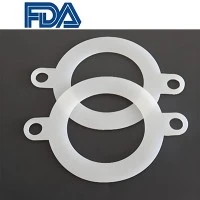


FDA-Approved Gaskets for Food, Beverage and Pharmaceutical Equipment
FDA-approved gaskets are sealing components made from materials permitted for intended food-contact applications under applicable U.S. FDA requirements. For sanitary equipment, material selection alone is not enough: the gasket compound, markings, adhesives, cleaning process, temperature, pressure and actual contact conditions all need to be considered together.
For food, beverage and pharmaceutical equipment, Jinshun supplies custom molded rubber gaskets using compounds such as EPDM, NBR and other application-specific elastomers, with material and compliance documentation available according to project requirements.
Product Overview & Custom Rubber Molding Capabilities
A gasket in a food-contact system has a job beyond simply stopping leakage. It must maintain its sealing force while exposed to product fluids, cleaning chemicals, temperature cycling and repeated assembly or CIP operations. Small cracks, damaged surfaces or an unsuitable compound can create areas that are difficult for cleaning solutions to reach, increasing contamination risk.
FDA-approved gaskets therefore need to be selected according to the complete operating environment rather than by material name alone. EPDM, NBR, PTFE and other materials may be suitable for different food-contact conditions, but the correct choice depends on the media, temperature, pressure and cleaning regime.
Jinshun manufactures custom molded rubber gaskets for food processing equipment, sanitary couplings, water treatment systems, beverage equipment and other industrial assemblies. The manufacturing process can be adapted to the required gasket geometry, dimensions, rubber compound and production volume.
As a China gasket manufacturer, Jinshun supports OEM production from drawing and sample evaluation through mold development, rubber molding and quality inspection. Materials are selected against the actual service conditions, while applicable documentation can be provided for procurement and compliance review.
For projects requiring a NSF61 certified rubber seal, FDA-compliant elastomer, or custom food-contact gasket, the specification should identify the exact compound and intended use rather than relying on a generic "food grade" description.
Engineering CTA: Send your gasket drawing, sample, compound requirement and operating conditions to Jinshun. Our engineering team can review the sealing geometry, material selection and compliance requirements before quotation.
Technical Specifications & Material Parameters
The following table summarizes the key material and engineering factors relevant to FDA-approved gasket selection. Actual values depend on the selected compound and grade; the final specification should be confirmed against the applicable material data and regulatory documentation.
| Parameter | Typical Requirement / Available Option | Engineering Consideration |
|---|---|---|
| Product Type | Molded rubber gasket | Custom profile, dimensions and geometry |
| Common Materials | EPDM, NBR, PTFE and other compliant compounds | Select according to food media and cleaning conditions |
| Hardness | Compound dependent; commonly specified by Shore A | Controls sealing force and deformation |
| Temperature Range | Compound dependent | Must cover process and CIP temperatures |
| Compression Set | Compound dependent | Lower compression set generally supports long-term sealing |
| Tensile Strength | Compound dependent | Used when mechanical durability is important |
| Elongation | Compound dependent | Relevant to installation and dimensional recovery |
| Food Contact | FDA requirements applicable to intended use | Verify compound and formulation |
| Drinking Water | NSF/ANSI/CAN 61 where specified | Certification must match the intended application |
| Chemical Compliance | RoHS / REACH available according to material | Useful for international procurement |
| Dimensions | Custom drawing or sample | Critical dimensions should be toleranced |
| Manufacturing | Compression / injection molding as applicable | Process selected according to geometry and volume |
| Surface Finish | Application dependent | Important for sanitary sealing interfaces |
| Traceability | Material and production documentation available as required | Supports QA and supplier audits |

Material Selection for FDA Food-Contact Gaskets
EPDM Rubber Gaskets
EPDM is widely considered for water, hot water, steam and many cleaning environments because of its resistance to weathering, ozone and polar media. For food and beverage equipment, the specific EPDM compound must be verified for the intended food-contact conditions.
EPDM can be a strong candidate for sanitary water systems and beverage equipment where petroleum-based fluids are not the primary service medium.
NBR Rubber Gaskets
NBR offers good resistance to mineral oils, fuels and many petroleum-based fluids. It can therefore be useful where a food-processing machine contains lubricants or other oil-based service media, provided the selected compound is permitted for the intended contact application.
The food-contact status of an NBR gasket is determined by its specific formulation and compliance documentation-not simply because the base polymer is NBR.
PTFE Gaskets
PTFE is frequently specified where very low chemical reactivity and broad chemical resistance are required. It has a different mechanical behavior from elastomeric rubber, so gasket design, compression and flange conditions need to be evaluated accordingly.
Material Selection Checklist
Before placing a production order, provide the gasket supplier with:
- Food, beverage or pharmaceutical medium in contact with the gasket.
- Continuous and peak operating temperature.
- System pressure and vacuum conditions.
- CIP or SIP cleaning procedure.
- Cleaning-agent concentration and exposure time.
- Gasket dimensions and compression conditions.
- Required FDA, NSF or other market-specific documentation.
This information allows the material engineer to distinguish between a nominally compliant compound and one that is actually suitable for the application.
Food-Contact Compliance: What Buyers Need to Check
FDA Compliance Is Not Just a Material Label
The supplied source material identifies 21 CFR 177.2600 as an important FDA requirement for rubber articles intended for repeated food contact. It addresses extraction limits for different food-contact conditions, including distilled water and fatty-food simulants.
For procurement teams, the practical point is simple: do not evaluate an FDA gasket from a product title alone. Request documentation identifying the actual rubber compound, manufacturer, intended contact conditions and applicable compliance basis.
Markings and Identification
A gasket may carry molded markings, part numbers or identification codes. These materials should also be evaluated for food-contact suitability where they can come into contact with the product.
This matters for traceability. A compliant gasket with an unsuitable marking system can create a different compliance problem at the component level.
Adhesives and Secondary Materials
Some gasket assemblies use adhesives or bonding agents. If an adhesive comes into the food-contact area, it cannot be ignored simply because the primary gasket material is compliant.
The same principle applies to lubricants, coatings and post-production treatments.
Need FDA documentation for a custom molded gasket
Quality Control & Testing Standards
Food-contact sealing components require control at both the material level and dimensional level. A gasket can use a suitable compound and still fail in service because of excessive flash, dimensional variation, poor compression or surface defects.
Jinshun's quality system is certified to ISO 9001:2015 and ISO 14001:2015. Depending on the product specification, quality control can include:
Material Verification
Rubber compounds should be controlled by formulation and batch identification. Material documentation and applicable test reports help establish traceability between the approved compound and production batch.
Dimensional Inspection
Critical dimensions such as:
- Inside diameter
- Outside diameter
- Cross-section
- Thickness
- Hole diameter
- Sealing lip geometry
- Flash or parting-line condition
should be measured against the approved drawing.
Compression and Physical Testing
Where specified, physical testing can include hardness, tensile strength, elongation and compression-set evaluation. These values provide engineering evidence of whether the compound can maintain sealing performance under the specified conditions.
Surface and Molding Inspection
Molded gaskets should be inspected for:
- Cracks
- Cuts
- Voids
- Surface contamination
- Incomplete filling
- Excessive flash
- Parting-line defects
- Dimensional deformation
For high-volume programs, automated or semi-automated inspection can be incorporated according to the product geometry and inspection requirements.
Cleaning and Gasket Service Life
A gasket in a food-processing line may experience repeated cleaning cycles rather than a single static operating condition.
During CIP, the gasket can see changes in:
- Temperature
- Chemical concentration
- Flow velocity
- Pressure
- Exposure duration
- Expansion and contraction
- Mechanical compression
The gasket must remain intact while maintaining sufficient contact pressure against the mating surfaces.
A practical maintenance program should therefore monitor gasket condition rather than waiting for visible leakage. Cracking, swelling, flattening, hardening, surface damage and permanent deformation are reasons to investigate the gasket material and service conditions.
The source material also highlights a key sanitation issue: small cracks may prevent cleaning agents from reaching contamination sites effectively. For sanitary equipment, gasket inspection is therefore part of the overall hygienic design strategy.
Typical Application Scenarios
Food Processing Equipment
FDA-compliant molded rubber gaskets can be used in equipment such as:
- Mixing vessels
- Kettles
- Processing tanks
- Pumps
- Valves
- Sanitary couplings
- Fluid transfer equipment
The compound should be matched to the food medium and cleaning regime.
Beverage and Dairy Equipment
Beverage dispensing and dairy processing equipment commonly require controlled sealing around fluid connections. EPDM and other food-contact compounds may be considered depending on temperature, chemistry and cleaning requirements.
Water Filtration Systems
Gaskets and O-rings are used throughout drinking water filtration equipment, including housings, connectors, valves and filter interfaces.
Where NSF61 certified rubber seals are required, certification should be verified against the exact compound and intended drinking-water application.
Pharmaceutical and Cosmetic Equipment
Pharmaceutical and cosmetic processing systems require close attention to contamination control. Material selection should consider cleaning chemicals, temperature cycles and the required regulatory documentation.

Custom Molded Gasket Manufacturing for OEM Programs
A production gasket is normally specified from an engineering drawing rather than a generic catalog size. Jinshun can work with customer drawings, samples and application requirements to develop custom rubber sealing components.
The manufacturing workflow can include:
Application review → Material selection → Drawing review → Mold development → Sample production → Dimensional inspection → Compliance documentation → Mass production
For OEM programs, the drawing should identify critical dimensions, tolerance requirements, rubber compound, hardness, surface requirements and inspection criteria.
For food-contact applications, the purchase specification should also identify the required regulatory market and documentation. This prevents a common procurement problem: approving the physical part first and discovering later that the material paperwork does not cover the intended application.
Why Source FDA-Compliant Gaskets from Jinshun?
Xiamen Jinshun Sealing Technology Co., Ltd. has manufactured rubber sealing products since 2002, serving applications in food and drinking water, sanitary products, electronics, machinery and automotive components.
The company manufactures:
- Rubber O-rings
- Y-seals
- Silicone gaskets
- RO membrane seals
- Silicone tubes
- Molded rubber gaskets
- Custom rubber components
Jinshun operates under ISO 9001:2015 and ISO 14001:2015 quality and environmental management systems. Raw materials are controlled for applicable RoHS, REACH and PAHS requirements, while product-specific certifications and compliance documentation can include FDA, NSF, LFGB, ACS, KTW-W270, WRAS and UL, depending on the material and application.
For international buyers, the important distinction is between a general material claim and documentation tied to the actual compound and intended use. Jinshun can support this distinction during material approval, sample evaluation and production.
FDA-Approved Gaskets FAQ
Are FDA-approved gaskets suitable for all food-processing applications?
No. FDA compliance does not mean every gasket is suitable for every food or cleaning condition. The compound must match the food medium, temperature, pressure and CIP chemicals, with documentation covering the intended use.
Can Jinshun manufacture custom FDA gaskets from a customer drawing?
Yes. Jinshun produces custom molded rubber gaskets from customer drawings, samples or specifications. The project can include material selection, mold development, sample approval, dimensional inspection and production documentation.
Can you provide NSF61 certified rubber seals for drinking-water equipment?
Yes, product-specific NSF/ANSI/CAN 61 requirements can be evaluated. Buyers should provide the intended water-contact application, compound requirement, dimensions and target market so the applicable certification and documentation can be confirmed.
Request A Custom FDA Gasket Quote
Send your CAD drawing, sample dimensions, rubber compound, hardness, operating temperature, pressure, food or chemical medium, CIP conditions and required FDA/NSF documentation to Xiamen Jinshun Sealing Technology Co., Ltd.
For OEM and volume programs, Jinshun can review the sealing geometry and material requirements before production, helping your purchasing and QA teams establish the correct specification from the start.
Request a factory-direct quotation for FDA-approved gaskets and custom molded rubber parts.


