




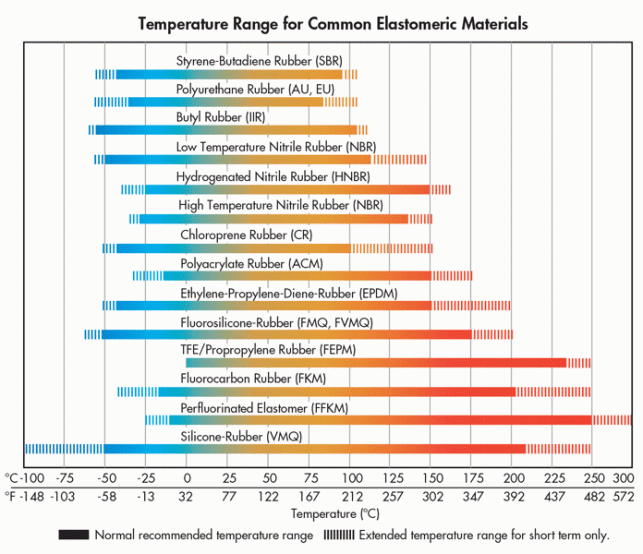
Below is the usage temperature range of common rubber materials:
Natural Rubber (NR)
Temperature range: -50°C to +80°C
Characteristics: Good elasticity and wear resistance but poor resistance to high temperatures and oils.
Styrene-Butadiene Rubber (SBR)
Temperature range: -40°C to +100°C
Characteristics: Good wear resistance and aging resistance, commonly used in tire manufacturing.
Nitrile Rubber (NBR)
Temperature range: -30°C to +120°C
Characteristics: Excellent oil resistance, suitable for oil-based media environments.
Chloroprene Rubber (CR)
Temperature range: -40°C to +120°C
Characteristics: Good weather resistance, ozone resistance, and flame resistance.
Ethylene Propylene Diene Monomer (EPDM)
Temperature range: -50°C to +150°C
Characteristics: Excellent weather resistance, ozone resistance, and chemical resistance.
Silicone Rubber (VMQ)
Temperature range: -60°C to +230°C
Characteristics: Exceptional high and low-temperature resistance but relatively low mechanical strength.
Fluoroelastomer (FKM)
Temperature range: -20°C to +200°C
Characteristics: Excellent high-temperature resistance, oil resistance, and chemical corrosion resistance.
Polyurethane Rubber (PU)
Temperature range: -30°C to +80°C
Characteristics: High wear resistance and elasticity, often used in seals and wear-resistant components.
Acrylate Rubber (ACM)
Temperature range: -10°C to +150°C
Characteristics: Good high-temperature and oil resistance, suitable for automotive seals.
Hydrogenated Nitrile Rubber (HNBR)
Temperature range: -40°C to +150°C
Characteristics: Superior high-temperature resistance, oil resistance, and chemical resistance compared to standard nitrile rubber.
These temperature ranges are typical values and may vary depending on specific formulations, environmental conditions, and application scenarios.
New chat