




High-Temperature O-Ring Materials
Heat accelerates elastomer aging and can change hardness, elasticity, compression set and sealing performance. Different polymer families therefore serve different temperature and chemical environments.
The following temperature values are engineering reference ranges for the material families specified below:
| Material | Standard Material Code | Reference Temperature Limit | Typical Selection |
|---|---|---|---|
| Perfluoroelastomer | FFKM | Up to 316°C / 600°F | Extreme-temperature and chemical service |
| TFE-Propylene | FEPM / AFLAS® | Up to 232°C / 450°F | High-temperature industrial sealing |
| Fluorocarbon | FKM / Viton® | Up to 204°C / 400°F | Heat, oil and selected chemical service |
| Fluorosilicone | FVMQ | Up to 204°C / 400°F | Heat and selected fuel/fluid service |
| Silicone | VMQ | Up to 204°C / 400°F | High-temperature flexibility and selected media |
Terminology note: TFE-Propylene is commonly designated FEPM, with AFLAS® being a well-known commercial material name. Fluorosilicone is correctly designated FVMQ; "FMQ" is not the preferred material code for this application.
These values should not be treated as universal limits for every compound. Elastomer formulations can be modified for different hardness, chemical resistance, compression-set behavior and temperature requirements.
Temperature Is Only One Selection Variable
A high-temperature O-ring may perform well in one application and fail prematurely in another at the same nominal temperature. The sealing medium, pressure, mechanical movement and exposure duration can change the actual service limit.
Before approving a material, specify:
- Continuous operating temperature
- Peak temperature
- Sealing medium
- Operating and peak pressure
- Static or dynamic sealing
- Thermal cycling
- Compression level
- Required compression-set resistance
- Wear and friction conditions
- Expected service life
For equipment that repeatedly moves from hot to cold conditions, thermal cycling deserves particular attention. The O-ring must maintain sufficient elastic recovery as temperature and component dimensions change.
Send Jinshun the operating temperature
What Causes O-Ring Failure at High Temperatures?
When an O-ring operates above the practical temperature limit of its compound, the elastomer can lose physical properties. Hardening, embrittlement and permanent deformation can progressively reduce contact pressure and eventually cause leakage.
Hardening and Embrittlement
Excessive thermal exposure can alter the polymer structure and reduce elasticity. As the O-ring becomes harder, it has less ability to accommodate small dimensional changes or surface irregularities in the gland.
Typical failure symptoms include:
- Increased hardness
- Reduced elastic recovery
- Surface cracking
- Loss of sealing contact
- Leakage after thermal cycling
- Brittle fracture in severe cases
Compression Set
Compression set is particularly important for static high-temperature sealing.
An O-ring is compressed inside a gland to generate contact pressure. Prolonged heat exposure can reduce the material's ability to recover after compression. If recovery becomes insufficient, sealing force falls and leakage can occur.
This is why a material with a higher nominal temperature rating is not automatically the correct choice. Compression-set performance at the actual temperature and in the actual medium must also be considered.
Thermal Cycling
A component operating continuously at 180°C has a different sealing requirement from one cycling between ambient temperature and 180°C.
Repeated thermal expansion and contraction can affect:
- O-ring compression
- Contact pressure
- Elastic recovery
- Dimensional stability
- Leakage resistance
- Interface movement
The supplied reference values are intended for long-term functional service rather than short-duration temperature spikes. The original engineering specification indicates a 1,000-hour functional-service basis when exposed continuously to the stated temperature; actual performance still depends on compound, medium and application conditions.
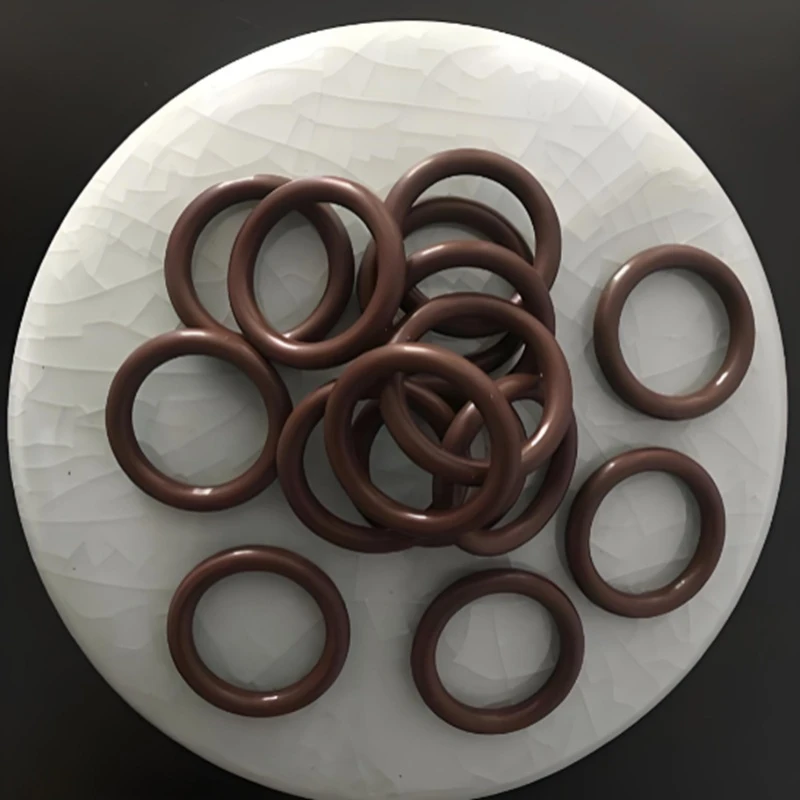
FFKM, FEPM, FKM, FVMQ and VMQ O-Ring Selection
Each elastomer has a different balance of heat resistance, chemical compatibility, flexibility and mechanical behavior. Material selection should start with the actual sealing environment rather than the material's maximum temperature alone.
FFKM O-Rings
FFKM, or perfluoroelastomer, is used for some of the most demanding sealing environments. The supplied reference limit is approximately 316°C / 600°F.
FFKM is generally considered when both very high temperature resistance and broad chemical resistance are required. It is often selected only after the process temperature and media rule out lower-cost elastomer families.
FEPM / AFLAS® O-Rings
TFE-Propylene is correctly identified as FEPM, while AFLAS® is a commercial material designation.
The supplied reference limit is approximately 232°C / 450°F. FEPM compounds can be evaluated for high-temperature industrial sealing where the combination of temperature and process media requires a fluorinated elastomer.
FKM / Viton O-Rings
FKM is a fluorocarbon elastomer widely used for elevated-temperature sealing. The supplied reference limit is approximately 204°C / 400°F.
FKM is commonly considered where heat resistance and compatibility with selected oils, fuels and chemicals are required. Viton® is a registered trademark associated with specific FKM products, so the exact compound should always be identified rather than treating the trademark as a generic material name.
FVMQ Fluorosilicone O-Rings
The correct material designation for fluorosilicone is FVMQ. Fluorosilicone combines the temperature characteristics of silicone with improved resistance to selected fuels and fluids compared with standard VMQ.
The supplied reference limit is approximately 204°C / 400°F. Actual compatibility depends on the specific compound and sealing medium.
VMQ Silicone O-Rings
VMQ is the standard designation for silicone elastomer. The supplied reference limit is approximately 204°C / 400°F.
Silicone O-rings are valued for temperature flexibility, but VMQ is not a universal solution for petroleum-based fluids, aggressive chemicals or high-abrasion dynamic sealing. The fluid, pressure and movement should be checked before material approval.
Engineering CTA: If the application requires a custom high-temperature rubber O-ring, send a drawing, sample or dimensional specification. Jinshun can review the required ID, OD, cross-section, hardness, compound and operating conditions before production.
High-Temperature Rubber O-Ring Technical Parameters
| ParameterEngineering Specification | |
|---|---|
| Product | High-temperature rubber O-rings |
| FFKM | Up to 316°C / 600°F reference limit |
| FEPM / AFLAS® | Up to 232°C / 450°F reference limit |
| FKM / Viton® | Up to 204°C / 400°F reference limit |
| FVMQ | Up to 204°C / 400°F reference limit |
| VMQ | Up to 204°C / 400°F reference limit |
| Sealing medium | Liquid, gas, oil, fuel, water or chemicals |
| Temperature condition | Continuous, peak and cyclic temperature should be specified |
| Sealing mode | Static, reciprocating or rotary |
| Pressure | Operating and peak pressure required |
| Compression | Defined by gland geometry and application |
| O-ring dimensions | ID, OD and cross-section |
| Material hardness | Specified according to application |
| Customization | Material, dimensions, hardness and color |
| Manufacturing | Custom molded rubber O-ring production |
| Quality system | ISO 9001:2015 and ISO 14001:2015 |
| Raw-material requirements | RoHS, REACH and PAHS |
| Available compliance | NSF, FDA, LFGB, ACS, KTW-W270, WRAS and UL for applicable products |
| Applications | Food, drinking water, sanitary, electronics, machinery and automotive |
Custom High-Temperature O-Ring Manufacturing
For a custom O-ring, material and geometry need to be considered together. A technically suitable elastomer can still leak if the cross-section, gland compression or dimensional tolerance is wrong.
Jinshun manufactures customized rubber O-rings from customer drawings, samples and application specifications. Depending on the project, customization can include:
- Inner diameter
- Outer diameter
- Cross-section
- Elastomer compound
- Hardness
- Color
- Mold geometry
- Dimensional tolerance
- Operating temperature
- Sealing medium
For a new component, a technical drawing or physical sample is preferred. Operating temperature, pressure, medium and sealing movement should also be supplied so the material and geometry can be reviewed together.
Dimensional Control for High-Temperature O-Rings
Consistent dimensions are particularly important when the O-ring operates across a wide temperature range. Variations in cross-section or diameter can change gland fill, compression and contact pressure.
Production inspection can cover:
Inner diameter
Outer diameter
Cross-section
Flash and parting-line condition
Surface defects
Hardness
Compression-set requirements
Tensile and elongation requirements where specified
Material and batch traceability
Quality Control and Material Compliance
Xiamen Jinshun Sealing Technology Co., Ltd. was established in 2002 and operates under ISO 9001:2015 and ISO 14001:2015 quality and environmental management systems.
For an engineered sealing component, compliance documentation should identify the actual material or compound supplied. A factory-level certification does not by itself prove that every O-ring compound meets every application-specific requirement.
Jinshun specifies raw materials to meet applicable RoHS, REACH and PAHS requirements. Depending on the p
roduct and target market, applicable products can also be supplied with documentation or approvals associated with NSF, FDA, LFGB, ACS, KTW-W270, WRAS and UL.
For high-temperature O-rings, purchasing and QA teams should define:
| QA Item | Recommended Requirement |
|---|---|
| Elastomer | Exact polymer and compound |
| Hardness | Shore A target and tolerance |
| Dimensions | ID, OD and cross-section |
| Appearance | No cracks, cuts or unacceptable flash |
| Temperature | Continuous and peak values |
| Medium | Exact fluid, gas or chemical |
| Compression set | Test temperature and acceptance criteria |
| Batch traceability | Material and production batch |
| Compliance | Destination-market requirements |
| Sample approval | First-article or approved sample |
This gives procurement and QA teams a measurable basis for supplier qualification and incoming inspection.
Typical Applications for High-Temperature Rubber O-Rings
High-temperature O-rings are used in equipment where an elastomeric seal must maintain contact while exposed to elevated temperatures.
Industrial Machinery
Applications include pumps, valves, process equipment, heated fluid systems and machinery connections, subject to material and pressure compatibility.
Automotive Components
FKM, FVMQ and other heat-resistant compounds can be evaluated for engine-area components, fluid connections and assemblies exposed to elevated temperatures.
Electronics and Electrical Equipment
VMQ and selected fluorinated elastomers can be considered where heat exposure, environmental sealing and elastic recovery are required.
Food and Drinking-Water Equipment
For food or drinking-water contact, temperature resistance and regulatory suitability are separate requirements. The exact compound and applicable documentation must match the intended application.
Sanitary and Bathing Products
Custom O-rings and molded rubber seals can be used in valves, fittings, cartridges and water-handling assemblies when the compound is compatible with the operating conditions.
Chemical and Process Equipment
FFKM, FEPM and FKM can be evaluated for demanding process environments. Final material approval should be based on the actual chemical, concentration, temperature, pressure and exposure time.

How to Specify a High-Temperature Rubber O-Ring
A purchase request that only states "high-temperature O-ring" does not provide enough information for reliable material selection.
A production specification should include:
- O-ring drawing or standard
- Inner diameter
- Outer diameter
- Cross-section
- Material or required performance
- Hardness
- Continuous temperature
- Peak temperature
- Pressure
- Sealing medium
- Static or dynamic operation
- Required certifications
- Color, if applicable
- Order quantity
- Packaging requirements
For custom production, a drawing or physical sample establishes the geometry. Jinshun's engineering team can then review material selection, dimensional requirements and molding considerations before production.
FAQ: High-Temperature Rubber O-Rings
What high-temperature rubber O-ring material can withstand 316°C?
FFKM, or perfluoroelastomer, has the highest reference temperature in this material list, up to approximately 316°C / 600°F. Actual service performance depends on compound formulation, medium, pressure, exposure duration and thermal cycling.
Can Jinshun manufacture custom high-temperature O-rings from a drawing or sample?
Yes. Jinshun manufactures custom O-rings according to drawings, samples and specified dimensions. Buyers can provide ID, OD, cross-section, material, hardness, color and operating conditions for engineering review before tooling and production.
What information should buyers provide when sourcing high-temperature O-rings?
Provide dimensions, material preference, hardness, continuous and peak temperature, sealing medium, pressure, static or dynamic movement, required certifications and quantity. These details allow the compound and O-ring geometry to be evaluated together.
High-Temperature Rubber O-Ring Manufacturer in China
Xiamen Jinshun Sealing Technology Co., Ltd. has manufactured rubber sealing products since 2002, including rubber O-rings, Y-seals, silicone gaskets, RO membrane seals, silicone tubes, molded rubber gaskets and customized rubber parts.
For a high-temperature O-ring project, send your drawing or sample + ID/OD/cross-section + temperature + medium + pressure + movement + required quantity.
Send Jinshun the operating temperature


