



Complete Guide to PTFE Step Seals
Design, Performance, Applications, and Selection Explained
Introduction
PTFE step seals-also known as PTFE step rings or hydraulic step seals-are among the most reliable sealing solutions used in modern hydraulic and pneumatic systems. If your equipment operates under high pressure, high speed, or aggressive media, step seals offer a proven balance of low friction, long service life, and stable sealing performance.
As a China Custom PTFE Step Rings Manufacturer and Exporter, Xiamen Jinshun Sealing Technology Co., Ltd. supplies engineered PTFE step seals for OEMs, distributors, and industrial users worldwide. This guide explains how PTFE step seals work, why their geometry matters, and how to select the right solution for your application.
Table of Contents
- What Is a PTFE Step Seal?
- Structure and Material Composition
- Why Step Seal Geometry Matters
- How PTFE Step Seals Work Under Pressure
- Key Advantages of PTFE Step Seals
- Technical Parameters and Performance Data
- How to Select and Install PTFE Step Seals
- Typical Applications Across Industries
- Why Choose Jinshun Sealing as Your Supplier
- Future Trends in Step Seal Technology
- FAQs
- Call to Action
A PTFE step seal is a high-performance sealing system consisting of:
- A step-profile PTFE sealing ring
- An elastomer energizing O-ring
This two-component structure creates a dual-barrier sealing effect. The PTFE ring provides low friction and wear resistance, while the O-ring delivers elastic preload, ensuring consistent contact with the sealing surface.
Step seals are widely used in hydraulic cylinders, pneumatic actuators, and industrial machinery where both static and dynamic sealing stability are required.
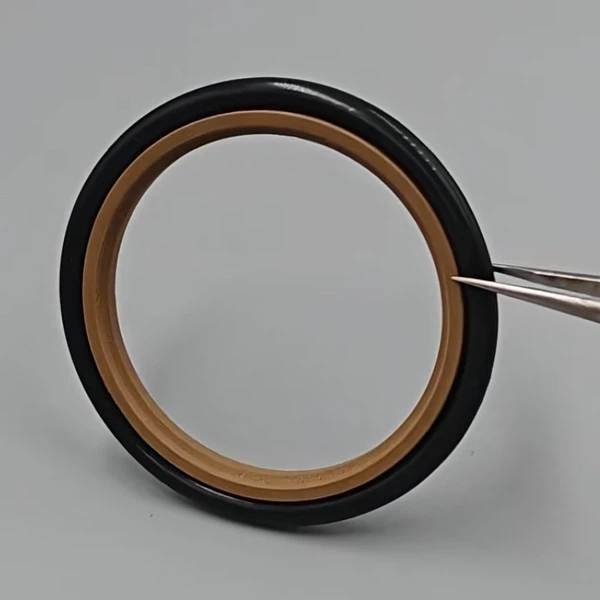
Main Sealing Ring (PTFE / Filled PTFE)
The sealing ring is typically machined from virgin PTFE or bronze-filled PTFE, offering:
- Extremely low friction
- Excellent wear resistance
- Stable performance at high pressure and speed
- Strong chemical and media resistance
Energizing O-Ring (NBR / FKM)
The O-ring applies continuous radial force to compensate for wear and pressure fluctuation.
- NBR O-ring: Suitable for mineral oils and standard hydraulic fluids
- FKM O-ring: Ideal for high temperatures and synthetic or aggressive media
Selecting the right material combination ensures optimal sealing under specific operating conditions.
The step-shaped profile is not decorative-it is precisely engineered.
Key geometric features include:
- 30°–45° sealing lip angle, allowing controlled oil film lubrication
- 0.1–0.3 mm micro-labyrinth channel, helping block contaminants without increasing friction
This geometry enables stable sealing even when piston speeds reach up to 15 m/s, significantly reducing wear and stick-slip behavior.
When system pressure increases:
- The pressure pushes the PTFE ring outward
- The O-ring maintains constant preload
- Sealing force automatically adjusts with pressure changes
This pressure-assisted sealing mechanism allows PTFE step seals to outperform many traditional rubber seals in fluctuating or high-load conditions.
PTFE step seals deliver measurable performance benefits:
- Ultra-low friction for smooth motion
- High abrasion resistance for long service life
- Excellent chemical and temperature resistance
- Bi-directional sealing capability
- Reduced maintenance and downtime
These advantages make them ideal for high-demand hydraulic sealing systems.

Standard Operating Conditions
| Parameter | Specification |
|---|---|
| Working Pressure | ≤ 80 MPa |
| Motion Type | Reciprocating |
| Sealing Direction | Bi-directional |
| Installation | Groove-mounted |
Temperature Range by O-Ring Type
| O-Ring Material | Operating Temperature |
|---|---|
| NBR | -20°C to +100°C |
| FKM | -20°C to +250°C |
Performance Benchmarks (Jinshun Sealing)
- Friction coefficient: 0.02–0.04
- Wear resistance: Up to 300% improvement vs. standard rubber seals
- Elastic stability: -45°C to +200°C
Selection Factors
When choosing a PTFE step seal, consider:
- Operating pressure
- Temperature range
- Fluid or gas media
- Piston speed and motion type
Installation Best Practices
For reliable sealing performance:
- Clean grooves and sealing surfaces thoroughly
- Avoid twisting or overstretching the O-ring
- Use proper installation tools
- Follow equipment manufacturer guidelines
Maintenance Tips
Regularly inspect for:
- Lip wear
- O-ring hardening or deformation
- Early signs of leakage
Early replacement prevents costly system failures.
PTFE step seals are widely used in:
- Hydraulic cylinders, pumps, and motors
- Construction machinery (excavators, loaders, presses)
- Pneumatic actuators and air cylinders
- Petrochemical reactors and pipelines
- Pharmaceutical and sanitary equipment
- Power generation turbines and generators
- Food processing and packaging machines
- Automotive engines and transmissions
- Aerospace and high-performance systems
As a professional PTFE Step Rings manufacturer in China, Jinshun Sealing offers:
- Precision PTFE machining with strict QC
- Multiple dedicated sealing production lines
- ISO-certified manufacturing systems
- OEM & ODM customization support
- Fast response and stable global delivery
- Experienced technical and export teams
We help international buyers reduce risk, improve sealing reliability, and control total operating costs.
The sealing industry continues to evolve:
- Advanced PTFE composites with nano-reinforcement
- Smart seals with wear-monitoring capability
- Eco-friendly manufacturing and recyclable materials
- Higher customization for industry-specific applications
Q1: Are PTFE step seals the same as PTFE step rings?
Yes. The terms are often used interchangeably depending on region and application.
Q2: Can PTFE step seals handle bi-directional pressure?
Yes. They are designed for effective two-way sealing.
Q3: Can Jinshun Sealing customize PTFE step seals?
Absolutely. Custom sizes, materials, and profiles are available based on drawings or samples.
Q4: What is the typical service life of a PTFE step seal?
With proper selection and installation, service life is significantly longer than standard rubber seals, even under high pressure.
Looking for a reliable PTFE Step Seals manufacturer in China?
Partner with Xiamen Jinshun Sealing Technology Co., Ltd. for:
- Custom PTFE step rings
- OEM & ODM sealing solutions
- Competitive pricing and fast delivery
👉 Visit: https://www.jinshunsealing.com/
👉 Contact us today for technical support, samples, and quotations.